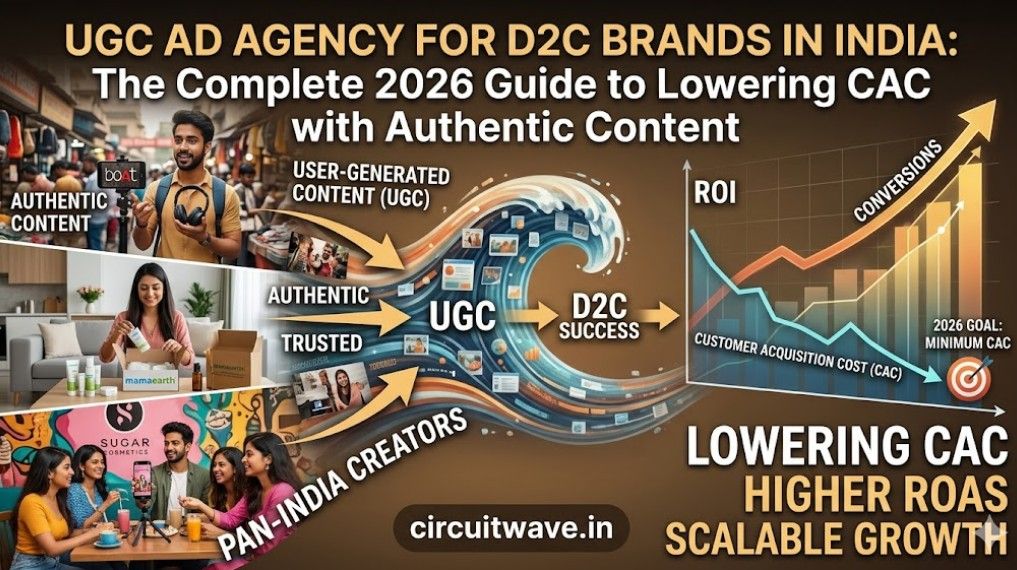
UGC Ad Agency for D2C Brands in India: The Complete 2026 Guide to Lowering CAC with Authentic Content
Key Takeaways
- Learn the latest Digital Marketing strategies for 2026.
- Actionable insights from the CircuitWave team.
- How to implement these changes in your own business.
The Real Problem: Your Ads Look Great and Convert Terribly
Your last ad shoot cost ₹1.2 lakh, took three days, and got skipped in under two seconds. Meanwhile, a customer's blurry phone video — filmed for free — is driving your competitor's best-performing campaign on Meta right now. If you run a D2C brand in India and haven't asked why, you're already behind on the metric that actually matters: cost per acquisition.
This isn't a creative preference question. It's a trust question. Indian consumers scrolling Instagram and YouTube Shorts have been trained by years of polished, agency-shot ads to distrust anything that looks too produced. The moment a video looks like an ad, the thumb moves. UGC — User Generated Content — works because it doesn't look like an ad until the hook has already landed.
Why UGC Matters More Than Production Value Right Now
[Likely] Performance marketers running D2C ad accounts in India have consistently reported that UGC-style creatives outperform studio-shot ads on click-through rate, largely because the format mimics the organic content the platform algorithm already favors. Three structural shifts are forcing this.
1. Ad fatigue has compressed attention to under two seconds
Feed scroll speed has only increased since Reels and Shorts became dominant ad inventory. A studio ad's first three seconds — usually a slow logo reveal or an establishing shot — is dead time the algorithm punishes before the value proposition even appears.
2. Privacy changes broke precision targeting
[Likely] D2C brands across India have reported customer acquisition cost increases in the 30–50% range over the past few years, largely because platforms can no longer target as precisely as before and now lean harder on creative quality to do the targeting's job. When the algorithm has less behavioral data, the creative has to self-select the right buyer on its own.
3. Trust has shifted from brand claims to peer proof
A founder claiming a product works reads as marketing. A customer saying the same thing on camera, unscripted, reads as evidence. This holds whether you're selling skincare, protein powder, or kitchen appliances.
UGC Production vs Traditional Studio Production
| Factor | Traditional Studio Production | UGC-Style Production |
|---|---|---|
| Cost per ad | ₹50,000 – ₹2,00,000+ | ₹3,000 – ₹15,000 |
| Turnaround time | 7–15 days | 2–5 days |
| Authenticity | Low — models, scripted delivery | High — real users, casual tone |
| Algorithm performance | Often throttled as overtly promotional | Treated closer to organic content |
| Scalability | Hard to produce variations quickly | Easy to test 10+ hooks per week |
| Best use case | Brand films, premium positioning | Cold-traffic acquisition, retargeting |
Neither format is universally better. [Likely] Most scaled D2C brands in India run a mix — UGC for cold-traffic acquisition, a smaller volume of polished content for the brand page and high-ticket positioning. The mistake is treating UGC as a cheaper substitute for studio work rather than a different tool solving a different problem: stopping the scroll on traffic that doesn't know you yet.
What a High-Converting UGC Program Actually Needs
Most agencies calling themselves UGC agencies in India today are creator-matching middlemen — they find a creator, send a brief, deliver a raw file, and disappear. That isn't a UGC ad program. A program built for ROI needs the following.
- A hook-testing system, not a single video — the first three seconds need five to ten variations tested simultaneously, because you cannot predict the winning hook from a brief alone
- A script structured around a real pain point, not a product feature list — 'I tried everything for my frizzy hair' consistently outperforms a list of active ingredients
- Creators who match the actual buyer, not creators with the biggest follower count — a 2,000-follower creator who looks like your customer often beats a 50,000-follower creator who doesn't
- Editing tuned to platform-native pacing — jump cuts, on-screen text, and caption timing differ across Meta, YouTube Shorts, and a website landing page
- A feedback loop into performance data — the agency should know which hooks, creators, and angles are winning on spend, not just delivering content and moving on
- Usage rights clarity upfront — most creator-brand disputes happen because a brand assumed unlimited paid usage rights that were never actually licensed
Step-by-Step: How a Proper UGC Ad Engine Gets Built
- Audit the existing funnel — review current ad account performance and identify exactly where creative fatigue or drop-off is happening before producing a single video
- Build a pain-point map — interview five to ten real customers, or mine existing reviews, to extract the exact language they use to describe the problem your product solves
- Brief and cast creators — match creator demographics and tone to the actual buyer persona, not the aspirational one
- Produce in batches, not one-offs — shoot eight to fifteen variations per cycle so there's enough volume to find statistically meaningful winners
- Launch as a structured test — run multiple hooks against the same offer with controlled spend, not a single best-guess ad
- Read performance at the hook level — measure three-second view rate and thumb-stop rate, not just final click-through rate
- Double down and iterate — take the top two or three performers and produce five or more new variations in the same style, retire the rest
- Feed winners into retargeting and landing pages — the same proof points that won attention in the ad should reappear in the post-click experience
What This Actually Costs in India (2026)
| Tier | What's Included | Monthly Investment |
|---|---|---|
| Starter | 4–6 UGC videos per month, 1–2 creators, basic editing | ₹25,000 – ₹45,000 |
| Growth | 10–15 videos per month, 4–5 creators, hook testing, performance reporting | ₹60,000 – ₹1,20,000 |
| Scale | 25+ videos per month, dedicated creator pool, full funnel integration with ad management | ₹1,50,000 – ₹3,50,000+ |
Most early-stage D2C brands overspend on a single high-production hero video before validating which message even resonates, then underspend on the testing volume that would have told them. [Guessing] The brands that win on CAC in this category tend to spend less per individual video and more on the number of variations tested per cycle.
Red Flags When Hiring a UGC Agency
- They quote a price before asking about your current ad account performance or CAC
- Their portfolio is just a folder of generic creator videos with no performance data attached
- No mention of usage rights or licensing terms anywhere in the contract
- They promise a specific ROAS number before testing a single creative
- Everything is delivered as one final video with no hook variations to test
- No process for reading platform-level metrics like three-second retention or thumb-stop rate
Where This Is Headed: 2027 and Beyond
[Guessing] AI-generated avatars and voice cloning are already being used to produce UGC-style ads without a human creator involved at all, and this will likely expand as the tools mature — though platforms have started flagging fully synthetic content differently, so a hybrid approach using real creators with AI-assisted editing and scripting is the safer bet through 2027. Expect three shifts: AI-assisted scripting will compress the pain-point research phase from days to hours, shoppable UGC embedded directly into landing pages will blur the line between ad and product page, and platform-native commerce through Instagram Shop and YouTube Shopping will turn the UGC video itself into the checkout surface rather than just the traffic driver.
Where CircuitWave Fits Into This
Most D2C founders we work with at CircuitWave don't actually have a creative problem first — they have a measurement problem. They're producing content with no system to know which three seconds worked and which didn't, which is the real gap a structured UGC engine closes. Once that ad traffic starts converting, the next bottleneck is almost always the same: a slow or generic landing page undoing everything the ad just earned. If that's where you are, our breakdown of realistic website costs and timelines in India is worth reading before briefing the next creative batch.
The other recurring gap is leads arriving through WhatsApp or Instagram DMs from UGC ads with no system to qualify them before a human gets involved. That's a separate fix, and we've covered it in detail in our guide to AI chatbots for lead generation.
The Bottom Line
UGC isn't a cheaper alternative to real advertising — it's the format that matches how Indian consumers actually consume content in 2026. The brands winning on CAC right now aren't necessarily the ones with the best production values; they're the ones running disciplined testing systems against real customer language. If the current approach is one expensive hero video every quarter, the wrong variable is being optimized. For a broader view of how Indian SMBs are restructuring their entire acquisition stack — CRM, automation, and lead routing alongside the ad spend — our digital transformation guide covers the adjacent pieces that make the spend actually pay back.
Ready to Get Started?
If the ad account is bleeding spend on creative that looks good but doesn't convert, the fix usually isn't a bigger budget — it's a better testing system. Contact Us to talk through what a UGC engine built around your actual customer data would look like.

Divyanshu Singh
Founder & Lead Strategist • B.Tech, Digital Transformation Expert
Divyanshu is a digital strategist with 5+ years of experience in building automation-first business architectures. He specializes in CRM deployments and lead-gen systems.
Transform Your Business with CircuitWave
Our specialized services are designed to move the needle for modern enterprises.


