AI Voice Agent for Appointment Booking: Cost, Use Cases & Setup Guide
Key Takeaways
- Learn the latest AI Automation strategies for 2026.
- Actionable insights from the CircuitWave team.
- How to implement these changes in your own business.
Your website may be generating traffic, your ads may be running, and your sales team may be working hard. Yet revenue can still leak through one very ordinary problem: people call when nobody is available, hang up when the line is busy, or lose interest when the callback takes too long.
For clinics, real estate firms, education consultants, salons, home-service companies, SaaS teams, and B2B service providers, the phone is still a high-intent channel. A caller is often closer to buying than someone casually browsing a page. If that caller reaches voicemail, waits too long, repeats the same information twice, or never gets a confirmed appointment, the business has paid to create demand but failed to capture it.
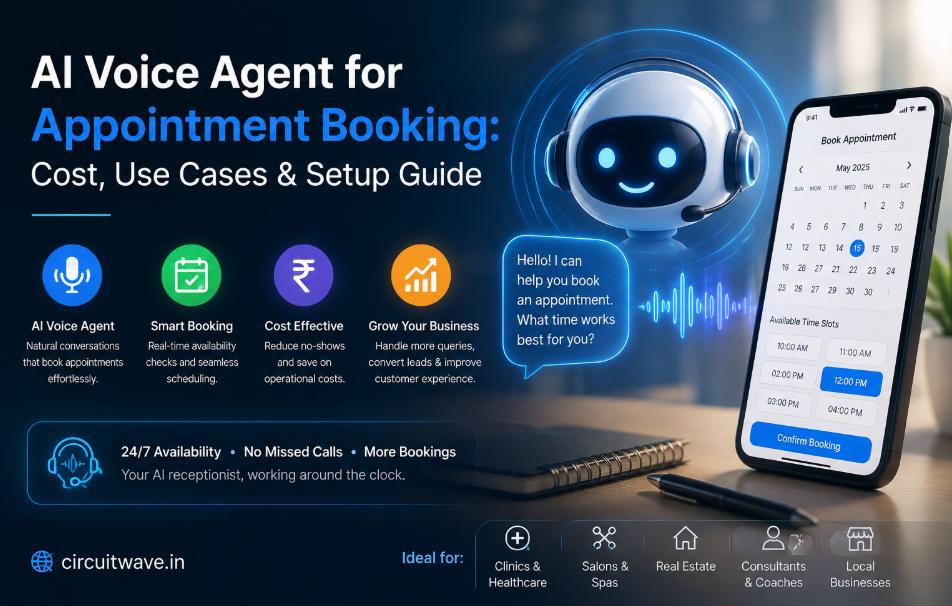
An AI voice agent for appointment booking is designed to reduce that gap. It can answer inbound calls, ask qualification questions, check calendar availability, book or reschedule appointments, send confirmations, update the CRM, and escalate complex cases to a human. The best implementations are not gimmicks. They are practical revenue operations systems that connect marketing, sales, customer service, and admin workflows.
This guide explains what an AI phone answering agent can do, where it fits, what it costs, how to set it up, and what mistakes to avoid.
What is an AI voice agent for appointment booking?
An AI voice agent for appointment booking is a software-based calling system that can speak with callers in natural language, understand intent, collect information, and complete predefined actions such as booking an appointment or creating a CRM record.
You may also hear similar terms:
- AI receptionist for small business: A virtual receptionist that answers calls, captures details, books slots, and routes callers.
- AI phone answering agent: A broader term for an AI system that answers inbound phone calls.
- AI call answering service: Often used by buyers comparing AI-based answering with traditional outsourced call answering.
- Voice bot: A conversational voice automation system, usually narrower than a fully integrated AI agent.
- AI live calling agent: A voice agent that can handle live phone conversations and trigger business workflows.
The important difference is that a modern AI voice agent is not just a menu-based IVR.
A traditional IVR asks callers to press 1, press 2, press 3, and often traps them in rigid branches. A voice agent can understand spoken language such as: I want to book a consultation next Tuesday, I need to reschedule my appointment, or I am looking for a two-bedroom apartment in Bandra.
A useful AI receptionist does three things well:
- Conversation: It understands the caller and responds clearly.
- Decisioning: It follows business rules for qualification, availability, routing, and escalation.
- Execution: It updates calendars, CRMs, WhatsApp or SMS workflows, support tools, and analytics dashboards.
CircuitWave builds this type of practical workflow under AI Automation, often combined with CRM, website, WhatsApp, and analytics systems.
Business impact: why voice automation matters
The business case is not that AI should replace every human conversation. The stronger case is that routine calls should be answered immediately, captured accurately, and routed consistently.
1. Fewer missed calls
Missed calls are not just operational noise. They are often missed opportunities. A prospect who calls after seeing an ad, searching on Google, or visiting a landing page is showing intent. If the call is unanswered, the lead may call a competitor instead.
Missed call automation can trigger an AI callback, SMS, or WhatsApp message asking whether the caller would like to book a slot, request pricing, or speak to a human.
2. Faster lead response
Speed matters because customer intent decays quickly. An AI phone answering agent can respond instantly, even outside business hours. For many businesses, this is less about replacing staff and more about covering nights, weekends, lunch breaks, peak hours, and overflow periods.
3. Better qualification data
Human teams often forget to ask the same qualification questions every time. A voice agent can collect structured details such as budget, location, urgency, service requirement, preferred date, insurance type, company size, or decision timeline.
This improves sales prioritization and CRM hygiene.
4. Lower admin workload
Appointment booking, rescheduling, reminders, FAQs, and call summaries consume valuable staff time. Automating repetitive parts gives human teams more time for complex, sensitive, or high-value conversations.
5. Improved customer experience
A good AI receptionist can be available 24/7, answer consistently, confirm details, and reduce back-and-forth. However, the experience must be designed carefully. If the agent cannot help, it should hand off quickly instead of pretending to know everything.
Best-fit examples by business type
The best use cases usually have repeatable call patterns, clear booking rules, and high value for fast response.
Example: Clinics and healthcare practices
A clinic may use an AI voice agent to answer appointment calls, ask whether the patient is new or returning, identify the department, collect preferred time, book available slots, and send confirmation. For clinics, privacy and escalation rules matter. Sensitive medical advice should remain with qualified professionals. If your clinic needs stronger patient tracking, read our guide on CRM for clinics in India.
Example: Real estate firms
A real estate business can qualify property inquiries by location, budget, property type, buying timeline, and financing status. The AI agent can book site visits or callbacks with the right sales executive.
Example: B2B service firms
A consulting, accounting, legal, IT, or marketing services company can use an AI receptionist to qualify leads by requirement, company size, geography, urgency, and budget range, then book discovery calls.
Example: Home services
Plumbers, electricians, pest control companies, cleaning businesses, and repair services can use automated appointment booking calls to collect address, issue type, urgency, preferred time, and photos through follow-up WhatsApp where appropriate.
Example: Education consultants
An education consultant can qualify students by destination country, course level, intake timeline, exam status, budget, and preferred counselling slot.
Example: Salons and wellness businesses
A salon can handle service selection, stylist preference, branch selection, available slots, rescheduling, and reminders.
Example: SaaS demo booking
A SaaS company can use an AI voice agent for lead qualification, demo scheduling, CRM updates, and routing enterprise prospects to senior sales teams.
Example: Local service businesses
A local business running paid ads or SEO can capture after-hours calls and avoid losing demand when staff are busy serving customers.
Core use cases for an AI appointment booking voice agent
An AI voice agent becomes more valuable when it handles the full call workflow rather than only answering the phone.
Inbound call answering
The agent greets callers, identifies intent, and routes the conversation. Common intents include booking, pricing, rescheduling, cancellation, directions, service availability, and speaking to a human.
Missed-call text-back and callback
If a call is missed, the system can trigger a text, WhatsApp, or AI callback. This is useful for businesses where staff cannot answer every call during peak hours.
Lead qualification
An AI voice agent for lead qualification can ask structured questions and score the inquiry. For example, a real estate agent may prioritize buyers with a defined budget and near-term purchase timeline.
Calendar booking
The agent checks availability in Google Calendar, Microsoft Outlook, Calendly-style tools, or a custom booking system. It confirms the date, time, timezone, service, and contact details before booking.
Rescheduling and cancellations
Instead of making customers wait for admin staff, the agent can help callers modify appointments within defined rules.
FAQ handling
The agent can answer approved questions about pricing ranges, working hours, location, documents required, consultation process, refund rules, or service coverage.
CRM updates
A strong implementation updates the CRM automatically. It can create a lead, add call notes, assign an owner, update qualification fields, and create follow-up tasks. If you are evaluating CRM foundations, explore CircuitWave’s CRM / ERP Development capabilities.
Call summaries
After the call, the system can generate a concise summary and next-step recommendation for the team.
Human transfer
The agent should transfer urgent, complex, sensitive, or high-value calls to a human when rules require it.
AI voice agent vs alternatives
Different channels solve different problems. The right choice depends on call volume, complexity, urgency, budget, and customer preference.
| Option | Best for | Strengths | Limitations | Typical role in the funnel |
|---|---|---|---|---|
| AI voice agent | Inbound calls, booking, qualification, missed-call recovery | 24/7 availability, structured data capture, CRM updates, scalable handling | Needs careful setup, testing, privacy controls, and handoff rules | Captures phone demand and books appointments |
| Human receptionist | Sensitive calls, VIP customers, complex judgment | Empathy, flexibility, nuanced understanding | Limited availability, training variation, capacity constraints | Handles exceptions and high-touch service |
| Call center | Higher call volume and multi-agent support | Human coverage at scale, process management | Can be expensive, variable quality, may still require scripting and QA | Supports broader customer service or sales operations |
| Traditional IVR | Simple routing | Predictable, low complexity | Frustrating for many callers, rigid menus | Directs calls to departments |
| Website chatbot | Web visitors who prefer typing | Good for FAQs, lead forms, guided journeys | Does not solve phone leakage | Captures website demand before or instead of calling |
| WhatsApp bot | Follow-ups, reminders, document collection | Familiar channel in many markets, asynchronous | Not ideal for every urgent conversation | Nurtures and confirms after the call |
A voice agent does not eliminate the need for a good website, CRM, or messaging workflow. It connects them. If your website is the first trust-building asset, make sure it supports conversion. CircuitWave’s Web Development team focuses on websites and landing pages that can feed clean leads into automation systems.
Where voice agents fit in the full funnel
An AI call answering service is most effective when it is part of a revenue system:
- Ads, SEO, referrals, and social content create demand.
- Your website or landing page builds trust.
- The prospect calls for speed or reassurance.
- The AI voice agent answers, qualifies, and books.
- The CRM records the lead, call outcome, and next step.
- WhatsApp, SMS, or email automation sends confirmations and reminders.
- Sales or service teams handle qualified conversations.
- Analytics shows which channels, scripts, and call flows create revenue.
This is also why AI voice agents should not be bought as isolated tools without workflow design. The biggest gains often come from connecting the voice layer to CRM ownership, follow-up sequences, and reporting.
For businesses already using chat automation, voice can complement web and messaging flows. If you are comparing channels, see our article on AI chatbot for lead generation in India.
Step-by-step implementation guide
A successful AI voice agent setup is mostly process design, not just software installation.
Step 1: Map your call types
Start by reviewing your last few weeks of calls if data is available. Categorize them into groups:
- New appointment booking
- Rescheduling or cancellation
- Pricing inquiry
- Location or working-hours question
- Existing customer support
- Sales inquiry
- Complaint
- Emergency or urgent request
- Vendor or non-customer call
Do not automate everything at once. Choose the repeatable, low-risk call types first.
Step 2: Define qualification criteria
Write down what makes a lead qualified. This varies by business.
A clinic may ask for department, patient status, preferred doctor, and appointment urgency. A B2B service company may ask for company size, budget range, requirement, and decision timeline. A real estate company may ask for location, property type, budget, and buying timeframe.
Avoid asking too many questions. The goal is to qualify enough to route and book, not interrogate the caller.
Step 3: Prepare approved business knowledge
The agent should answer only from approved sources. Prepare concise knowledge for:
- Services offered
- Locations served
- Opening hours
- Pricing policy or consultation fees
- Booking rules
- Cancellation rules
- Required documents
- Escalation instructions
- Team availability
- Compliance or privacy disclaimers
If information changes often, define who owns updates.
Step 4: Choose voice, tone, and script
The voice should match your brand. A clinic may need calm and reassuring language. A SaaS company may need crisp and professional language. A salon may prefer warm and friendly language.
Keep the opening short. For example: Hello, thanks for calling ABC Clinic. I can help you book or reschedule an appointment. How can I help today?
Step 5: Connect the phone number
You can use a new number, forward an existing number, or configure rules for after-hours and overflow calls. Decide whether the AI agent answers all calls or only specific conditions such as missed calls, nights, weekends, or high-volume periods.
Step 6: Integrate the calendar
Connect the booking system and define rules:
- Which services are bookable?
- How long is each appointment?
- Which staff members or locations are available?
- Are buffers needed between appointments?
- Can same-day bookings be made?
- What happens if no slot is available?
The agent must confirm details before creating or changing bookings.
Step 7: Integrate the CRM
AI voice agent CRM integration is where business value becomes trackable. The system should create or update records with:
- Name
- Phone number
- Email if collected
- Source if known
- Service interest
- Qualification answers
- Appointment time
- Call summary
- Call recording or transcript link if permitted and stored
- Lead owner
- Next step
For custom workflows, CircuitWave can help design custom CRM systems that connect calls, sales pipelines, operations, and reporting.
Step 8: Configure escalation
Escalation rules protect customer experience. Define when the AI should transfer or create an urgent task.
Escalate when:
- The caller is angry or distressed
- The caller asks for medical, legal, financial, or safety advice beyond approved information
- The caller is a VIP or high-value lead
- The agent is uncertain
- The caller requests a human
- The call involves cancellation disputes, refunds, complaints, or emergencies
Step 9: Test with real scenarios
Create test calls based on actual customer language. Include easy and difficult cases:
- I need an appointment tomorrow
- I do not know which service I need
- Can I talk to a doctor now?
- What is your price?
- I want to cancel
- I called yesterday and nobody responded
- I speak Hindi, can you help?
Review whether the agent understands intent, asks the right questions, and avoids overpromising.
Step 10: Launch on limited call types
Start with a controlled pilot. For example, launch after-hours appointment booking or missed-call recovery before using the agent for all inbound calls.
Step 11: Review transcripts and outcomes weekly
The first few weeks are optimization-heavy. Review transcripts, failed calls, handoffs, booking errors, and customer feedback. Improve scripts, knowledge, and routing rules.
Step 12: Expand after proof
Once the pilot is stable, expand to more call types, more locations, outbound reminders, multilingual support, or deeper CRM automation.
Technology and integration checklist
Before selecting a vendor or implementation partner, check the technology stack behind the promise.
| Component | What to check | Why it matters |
|---|---|---|
| Telephony | Number forwarding, call recording options, routing, uptime expectations | Determines how calls enter and exit the system |
| Speech-to-text | Accuracy in your target accents, languages, and noise conditions | Poor transcription creates poor decisions |
| LLM reasoning | Intent detection, context handling, guardrails | Helps the agent understand flexible customer language |
| Text-to-speech | Natural voice, latency, pronunciation control | Affects caller trust and call completion |
| Calendar API | Google Calendar, Outlook, custom scheduling, buffers | Enables real appointment booking |
| CRM | Lead creation, updates, tasks, owner assignment | Makes calls measurable and actionable |
| WhatsApp/SMS follow-up | Confirmations, reminders, document collection | Reduces no-shows and manual follow-up |
| Analytics dashboard | Outcomes, booking rate, missed-call recovery, handoffs | Shows whether the system is improving revenue operations |
| Data privacy controls | Consent, access control, retention, auditability | Essential for regulated or sensitive industries |
CircuitWave often combines AI live calling agents with WhatsApp and SMS follow-up automation, CRM / ERP systems, conversion-focused landing pages, and analytics dashboards so the voice workflow is connected to business outcomes.
Best practices for appointment booking voice agents
Keep scripts short
Callers do not want long explanations. Start with the caller’s goal, then collect only necessary details.
Disclose automation where appropriate
Depending on your market, industry, and call context, it may be appropriate or required to disclose that callers are speaking with an automated assistant. Even where not strictly required, transparency can build trust.
Use approved knowledge sources
Do not let the agent improvise policies, discounts, medical advice, legal advice, or financial commitments. Use a controlled knowledge base.
Confirm details before booking
The agent should repeat the name, phone number, appointment date, time, location, and service before confirming.
Set fallback rules
If the agent is uncertain, it should say so and offer a human callback or transfer.
Measure outcomes, not just calls handled
A system that answers many calls but books poor-fit appointments may hurt operations. Track quality, show-up rate, and revenue outcomes.
Keep humans in the loop
Human review is especially important during the pilot. Use call summaries and transcripts to improve the workflow.
Common mistakes to avoid
Automating complex calls first
Start with repeatable call types. Do not begin with complaints, emergencies, or complex advisory conversations.
No human handoff
A voice agent without a graceful handoff can frustrate callers. Always define transfer and callback rules.
Weak knowledge base
If business information is scattered across old PDFs, outdated web pages, and staff memory, the agent will struggle. Clean the knowledge base first.
Unclear booking rules
Double bookings, wrong appointment lengths, and staff availability conflicts usually come from poor rules, not from AI itself.
No consent or privacy process
Call recording, transcripts, personal data, and regulated industries require careful handling. Define what is collected, where it is stored, who can access it, and how long it is retained.
No CRM ownership
If nobody owns CRM data quality, call automation becomes another disconnected tool. Assign responsibility for fields, pipeline stages, duplicate handling, and reporting.
Measuring only cost savings
Cost reduction is useful, but the stronger value may come from faster response, recovered missed calls, better conversion, and cleaner follow-up.
KPIs to track
Track KPIs before and after implementation so the business impact is visible.
| KPI | What it tells you |
|---|---|
| Answered-call rate | How often calls are answered instead of missed |
| Missed-call recovery | How many missed callers are re-engaged through callback, SMS, or WhatsApp |
| Qualified-call rate | Percentage of calls that meet your qualification criteria |
| Booking rate | Percentage of relevant calls that become appointments |
| Show-up rate | Whether booked appointments actually happen |
| Average handling time | How long calls take and whether the script is efficient |
| Human handoff rate | How often the agent needs human support |
| No-answer callback rate | Whether follow-up attempts are successful |
| CRM completion rate | Whether required fields are captured correctly |
| Revenue per booked appointment | Whether the workflow is contributing to commercial outcomes |
Do not expect every KPI to improve at once. For example, handoff rate may be higher during the pilot as the team tunes the system.
Cost considerations
The cost of an AI voice agent for appointment booking depends on call volume, complexity, languages, integrations, compliance requirements, and how much customization is needed.
DIY tools
DIY platforms can work for simple call answering and booking flows. They may be suitable for small teams with basic requirements and internal technical comfort.
Common cost drivers include subscription fees, call minutes, phone numbers, calendar integration, and add-ons.
The trade-off is that DIY tools may become limiting when you need custom CRM logic, multi-location routing, strict escalation, analytics dashboards, or deeper workflow automation.
Custom AI voice agent
A custom AI voice agent is better when your call process is specific, your qualification logic is nuanced, or your systems are not standard. Setup effort includes discovery, script design, integration, testing, compliance review, and optimization.
Custom builds usually make sense when the cost of missed leads, admin time, or slow response is significant enough to justify a tailored workflow.
Managed automation partner
A managed partner helps map the process, build the agent, integrate systems, monitor performance, and improve weekly. This is often the best fit for teams that want business outcomes rather than another software tool to manage.
Cost components may include:
- Initial workflow discovery
- Voice agent configuration or development
- Telephony setup
- Calendar integration
- CRM integration
- WhatsApp or SMS automation
- Analytics dashboard setup
- Testing and quality assurance
- Ongoing monitoring and optimization
- Maintenance when policies, services, or team availability changes
A practical ROI review should compare the investment against missed-call leakage, staff admin time, lead response delays, booking errors, no-shows, and revenue from recovered appointments.
Future trends in AI voice appointment booking
Multimodal agents
Voice agents will increasingly combine calls with text, WhatsApp, email, forms, payment links, and document uploads. A caller may start by phone and complete details through a secure link.
Real-time CRM context
Agents will become better at recognizing existing customers, seeing open opportunities, checking previous interactions, and personalizing the next step.
Multilingual voice agents
Businesses in India, the United States, the United Kingdom, and the UAE often serve multilingual audiences. Support for Hindi, English, and regional languages will keep improving, but testing with real accents and customer phrases remains essential.
Outbound follow-up
Inbound answering is only one side. Voice agents can also follow up with missed leads, appointment reminders, renewal reminders, and post-service feedback calls when configured responsibly.
Agentic workflow execution
Future systems will not only talk and book. They will trigger multi-step workflows such as creating a quote request, assigning a technician, checking inventory, notifying a sales owner, and updating dashboards.
Website-to-phone personalization
As websites, CRMs, and call systems become more connected, businesses will be able to understand which landing page, campaign, or service page led to the call. This can make phone conversations more relevant and reporting more accurate. If your website is not ready for conversion tracking, a website performance audit can reveal gaps in speed, structure, and lead capture.
FAQs
Can an AI voice agent sound natural?
Yes, modern text-to-speech and conversation design can sound natural enough for many business calls. The bigger issue is not only voice quality but whether the agent understands intent, responds quickly, and follows business rules.
Can it book into Google Calendar?
Yes, an AI voice agent can be integrated with Google Calendar or other scheduling systems if the calendar rules are clear. It should check availability, confirm details, and create or update the booking.
Can it qualify leads?
Yes. An AI voice agent for lead qualification can ask structured questions, score or categorize the lead, and update the CRM. The qualification criteria should be defined before launch.
Can it handle Hindi or regional languages?
It can, depending on the speech recognition, voice model, and testing quality. For Indian businesses, Hindi-English mixed conversations and regional accents should be tested with real scenarios before full rollout.
Is it safe for healthcare or finance?
It can be used for administrative workflows such as appointment booking, basic FAQs, and routing, but sensitive advice, diagnosis, financial recommendations, and regulated decisions need strict controls and human oversight. Privacy, consent, retention, and access rules must be designed carefully.
What happens when it does not know an answer?
It should not guess. A well-designed agent says it does not have enough information, then offers a human transfer, callback, or support ticket.
Will an AI receptionist replace my staff?
Usually, the better goal is to reduce repetitive admin work and missed calls, not remove human expertise. Staff can focus on exceptions, relationship-building, complaints, and high-value conversations.
How long does implementation take?
Timelines vary by complexity. A simple booking flow can be piloted faster than a multi-location, multilingual, CRM-integrated system. The discovery, testing, and optimization phases are as important as the technical setup.
Do I need a CRM first?
You can start without a CRM, but CRM integration makes the system far more measurable. Without a central record, follow-up ownership and reporting often become weak.
Conclusion: use AI voice as part of a revenue system
An AI voice agent for appointment booking works best when it is connected to the full customer journey. It should answer calls quickly, qualify clearly, book accurately, update the CRM, trigger follow-ups, and hand off to humans when needed.
The businesses that get the most value are not simply buying an AI phone answering agent. They are fixing a revenue operations problem: demand is being generated, but calls, appointments, and follow-ups are not being captured consistently.
If you are considering an AI receptionist for small business operations, start with a pilot. Map your call types, choose one or two repeatable workflows, connect your calendar and CRM, and measure booking outcomes before expanding.
CircuitWave Solutions LLP helps teams design AI automation, AI live calling agents, WhatsApp and SMS follow-up automation, CRM / ERP systems, custom website development, conversion-focused landing pages, and analytics dashboards that work together.
Book a free AI automation audit with CircuitWave to map your call flow, missed-lead leakage, CRM handoff, and a practical AI voice agent pilot.

Divyanshu Singh
Founder & Lead Strategist • B.Tech, Digital Transformation Expert
Divyanshu is a digital strategist with 5+ years of experience in building automation-first business architectures. He specializes in CRM deployments and lead-gen systems.
Transform Your Business with CircuitWave
Our specialized services are designed to move the needle for modern enterprises.


